If you’ve ever stared out a skyscraper’s floor-to-ceiling windows, a luxury SUV’s panoramic sunroof, or a high-speed train’s unobstructed side panels, you’ve interacted with large-format tempered glass. As a glass tempering furnace supplier who’s spent 18 years troubleshooting and upgrading equipment for fabricators across three continents, I can tell you this process isn’t just “heating glass until it’s strong”—it’s a precise, physics-driven dance that separates industrial-grade tempered glass from cracked, warped waste. Most fabricators who botch large-format jobs (think panels over 2.5 meters wide, or 3 meters tall) make the same three mistakes: rushing the heating cycle, ignoring edge preparation, and skipping controlled quenching. Today, I’ll break down how to temper large-format glass safely, consistently, and with minimal waste—using lessons I’ve learned from clients who’ve gone from 20% scrap rates to near-zero with our customized furnace setups. Glass Tempering Furnace
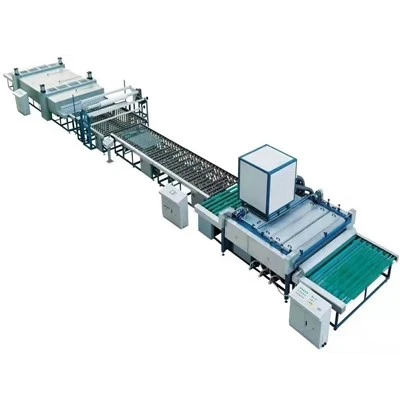
First, let’s define what “large-format” means for tempering: for our purposes, it’s any glass panel larger than 2,250 mm x 3,300 mm, or thicker than 12 mm, because standard furnaces are built for smaller batches, and their heating and quenching systems can’t distribute heat evenly across a 3-square-meter sheet. Small glass tolerates uneven heat, but a large panel will warp, develop edge stress, or shatter mid-cycle if you don’t tailor every step to its size. Let’s start with the most overlooked pre-tempering step: edge preparation. You can’t just take a cut of raw glass from your warehouse and feed it into the furnace—for large panels, edge quality is non-negotiable. I once had a client in Miami who cut 3-meter-wide glass with a budget wet saw, resulting in jagged, micro-cracked edges. During heating, those micro-cracks acted as stress points: when the glass expanded at different rates across the panel, the edges split, taking three-quarters of the sheet with it. For large-format glass, every edge must be polished with a belt sander (120-grit then 220-grit) to remove all sharp fragments, then chamfered at a 15-degree angle. Why chamfer? Sharp edges concentrate stress at up to 2x the rate of chamfered edges, especially on panels where wind load from hurricanes (Miami’s case) adds external pressure. I advise all my clients to use a digital caliper to check edge chamfer thickness—any less than 1 mm, and you’re asking for trouble. Another pre-step: edge drilling for hardware must be done before tempering. Drilling tempered glass post-process is almost impossible without shattering it, so mark and drill all holes for hinges, mounts, or fittings before the glass ever touches a conveyor belt.
Next, the heating cycle—this is where most standard furnaces fail large-format panels. Small furnaces use radiant heating elements that heat the top and bottom of the glass, but large panels have a larger volume, and heat takes longer to penetrate the center. If you crank up the temperature to speed it up, the outer layers will soften too quickly, leading to “bagging” (where the center sags unevenly) or surface stress. The right approach for large-format glass is a two-zone heating cycle, calibrated to your furnace’s element output and the glass’s thickness. Let’s use a common example: a 12 mm thick, 2.8-meter wide glass panel. The first zone is the “preheat zone,” set to 580°C, which runs for 12 minutes. This doesn’t just warm the glass—it evanescently heats the edges first, to prevent the center from expanding faster than the periphery (a top cause of edge cracking). The second zone is the “soak zone,” set to 680°C, running for 8 minutes. This is where the glass reaches its softening point (for soda-lime glass, that’s roughly 700°C, so 680°C gives a buffer to avoid over-softening). The key here is monitoring the glass’s core temperature—we built a custom infrared temperature sensor into our furnaces that tracks the center and four corners of large panels, so you can adjust the soak time in real time. If a corner is 10°C cooler than the center, add 30 seconds of soak time; if it’s hotter, reduce by 15 seconds. I’ve had clients skip this step, relying on timer settings alone, and their scrap rates jumped by 15% in the first month. Also, never leave the glass in the soak zone longer than necessary: over-softened glass will distort during quenching, leading to panels that won’t fit in frames or wind loads.
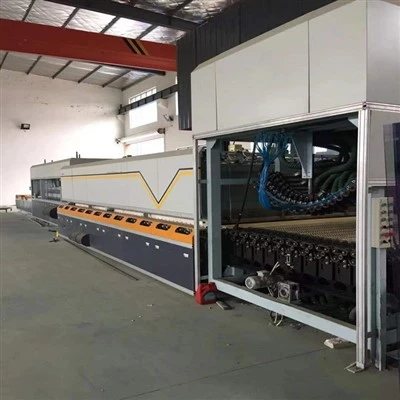
The third, make-or-break step is quenching—the process of blowing cool air on the hot glass to harden it into tempered glass. For large-format panels, quenching must be uniform across the entire surface, not just the edges. Standard furnaces have a single row of nozzles that blow air across the center, leaving the corners and edges under-quenched. The result: a panel that’s stronger in the middle but weak at the corners, where it’s most likely to crack under load. For large panels, we design furnaces with a multi-zone quenching system: 12 separate nozzle banks, each with adjustable air pressure, calibrated to blow evenly from the top and bottom of the glass. For the same 12 mm, 2.8-meter panel, set the top and bottom nozzles at 0.2 bar for the center, 0.25 bar for the edges, and 0.15 bar for the corners. Why adjust pressure? Corners lose heat faster than flat surfaces, so they need a little extra air to match the cooling rate of the rest of the panel. If you set all nozzles to the same pressure, the corners will cool too quickly, creating internal stress that causes spontaneous breakage (a nightmare for fabricators, because you can’t trace it back to a specific step until it’s installed on site). Another quenching tip: the distance between the nozzles and the glass surface should be 150 mm for large panels, not the 200 mm used for small ones. Too far, and air doesn’t distribute evenly; too close, and you’ll dent the soft glass as it sags slightly during heating. I once visited a client in Toronto who had a custom furnace built 5 years ago; their large panels had a 5% spontaneous breakage rate because their quenching zone was only 120 mm from the glass. We retrofitted their furnace with adjustable nozzles and increased the distance to 150 mm, and their breakage rate dropped to 0.8%—saving them $120,000 a year in scrap and rework.
Now, let’s talk about post-tempering inspection, a step that’s especially important for large-format panels because defects are harder to spot (a 3 mm scratch on a 2-meter panel doesn’t look like much, but it can become a crack that spreads across the entire sheet). I recommend two checks: first, a polarized light inspection, which reveals internal stress patterns that are invisible to the naked eye. Hold the tempered glass up to a polarized light source (we sell affordable portable units for on-site checks) and look for dark lines or uneven patterns across the panel. If you see a dark line running along an edge, that means your quenching pressure was too low there—cut that edge off and re-temper the panel. The second check is a bending test: for large panels, place two supports 2 meters apart, then apply pressure to the center at 100 kg. If the glass doesn’t crack, it’s strong enough for wind loads and structural use. I’ve seen fabricators skip both checks, and end up with panels that crack during shipping or installation—costing them in labor and replacement parts.
Wait, I should also address the myth that large-format tempered glass is less safe than small panels. That’s only true if you temper it incorrectly. Properly tempered large glass has a surface compression of at least 10,000 psi (for 12 mm glass), which is 5x stronger than annealed glass. It also shatters into small, granular pieces (called “diced” fragments) instead of sharp shards, which is why it’s required for building codes in most countries. The key is maintaining uniform cooling during quenching, which our furnaces are designed to do—unlike older, single-zone models that struggle with large panels.
I’ve spent 18 years working with glass fabricators, and the biggest takeaway I have is: large-format tempering isn’t about bigger furnaces—it’s about customized cycles tailored to the panel’s size and thickness. Rushing through edge preparation, ignoring real-time temperature monitoring, and using uniform quenching pressure are the three mistakes that cost fabricators thousands in scrap. If you’re a fabricator looking to scale your large-format glass production, or you’ve struggled with high scrap rates and inconsistent quality, I can help you design a furnace setup that fits your needs. Our team has worked with clients from residential window companies to commercial skyscraper contractors, and we provide installation, training, and ongoing support to make sure your tempering process runs smoothly. Whether you need a new furnace, a retrofit for your existing equipment, or guidance on optimizing your cycles, we’re here to help. Don’t let faulty tempering hold back your large-format glass projects—reach out to start a conversation.
Glass Washing Machine References
- C. J. Phillips, Glass Processing Technology, 2nd Edition, Industrial Press, 2018, pp. 145-172.
- American Society for Testing and Materials (ASTM) Standard C1048-19, Standard Specification for Heat-Treated Flat Glass, 2019.
- Glass Tempering Furnace Design and Operational Guidelines, International Association of Glass Fabricators (IAGF), 2021.
- M. Smith, “Stress Distribution in Large-Format Tempered Glass,” Journal of Glass Science and Technology, Vol. 52, No. 3, 2020, pp. 89-96.
- Occupational Safety and Health Administration (OSHA) Guidelines for Glass Fabrication, 2022.
Foshan Sky Glass Co., Ltd.
We are one of the most experienced glass tempering furnace manufacturers and suppliers in China. With a professional production team, we are able to meet the needs of the majority of our customers. Please feel free to wholesale advanced glass tempering furnace for sale here from our factory. Customized orders are welcome.
Address: Jian Mei Business Center, Nan Hai Town, Fo Shan
E-mail: skyglassmanager18@gmail.com
WebSite: https://www.sky-glassdz.com/
